Sketch to Image AI for Architecture: Midjourney vs RenderAI (2026)
Summarize with AI

Sketch to image AI takes a hand drawing, a line sketch or a 3D screenshot and turns it into a realistic or stylized image. This post compares two ways to do it for architecture: in Midjourney the sketch is a reference attached to a text prompt, and in RenderAI it is the image the render is built on, so the composition comes from your drawing.
This post was updated on October 19, 2026 to cover Midjourney V8.2 and compare it with RenderAI.
The Midjourney method today
The original version of this post followed the video Sketch-to-Photo with Midjourney “Remix Mode” by Christian Heidorn (Tokenized AI). He imports a scribble, remixes it with a new prompt, repeats the process a few times, generates variations and upscales the final image. The video was recorded in 2023 on an older Midjourney version, but the logic still applies.
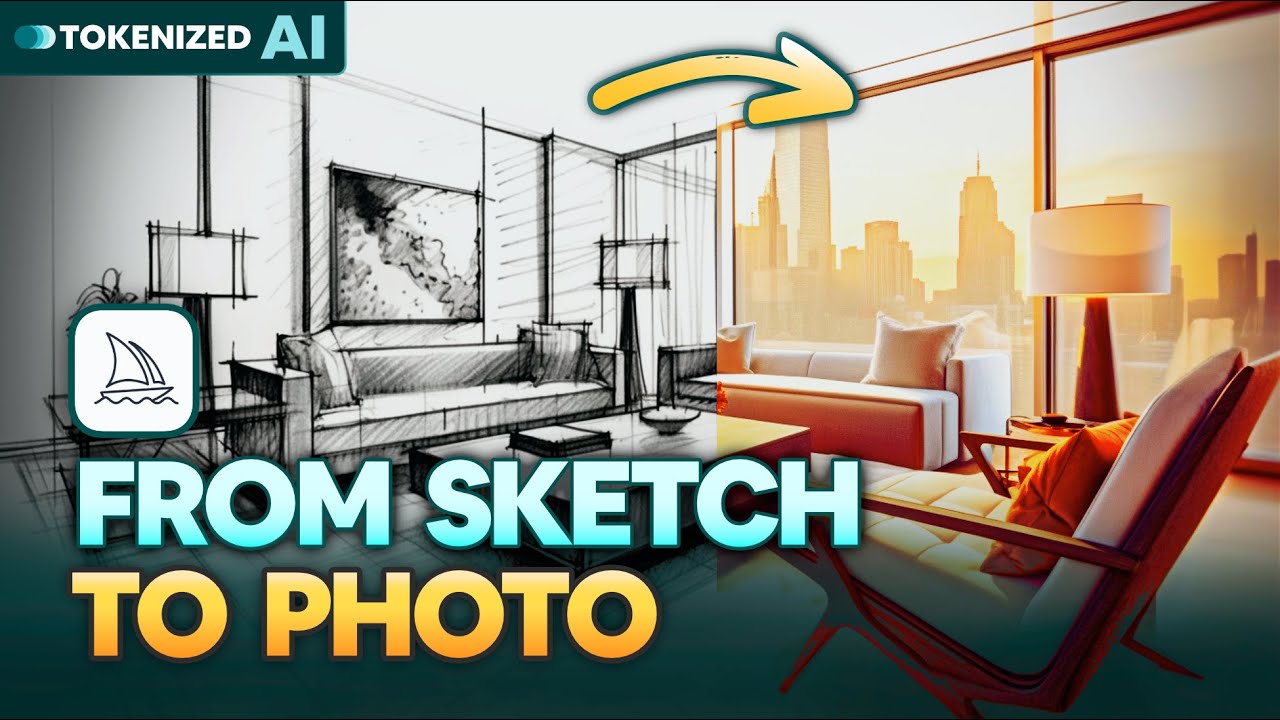
Watch the full video by Christian Heidorn on YouTube
As of October 2026, the default Midjourney model is V8.2, released as the default on July 24, 2026. These are the ways to use a sketch as input in the current version:
- Image Prompts. Attach the sketch to your prompt in the web app. The
--iw(image weight) parameter controls how strongly the image shapes the result. - Remix. Turn on Remix mode to change the prompt each time you create a variation. This is the method Heidorn uses, and Midjourney still lists it as compatible with V8.1 and V8.2.
- Edit Model. Released for testing with V8.2 on August 27, 2026. Drag an image into the prompt bar, or upload it in the Edit tab, and describe the change you want. It accepts up to 4 reference images and handles inpainting and outpainting. In V8 it replaces Omni Reference and Retexture.
For output size, HD mode in V8.1 and V8.2 renders images at 2048 px (2048 x 2048 px for a square image).

Basic sketch used to generate the images, by Christian Heidorn

First iteration using Remix, by Christian Heidorn

Sharpening edges and upscaling the final image, by Christian Heidorn
Limits for architects
Midjourney is a general image generator. That matters when the drawing is a real project and the client expects to see that building.
- Geometry and proportions. Midjourney documents image prompts as an influence on the result, adjusted with
--iw. It does not describe them as a constraint that locks lines, openings or proportions. In Heidorn’s video the sketch goes through several rounds of remixing before the result reads as a building. - Control. You steer the result with the prompt, image weight, style references and the Editor. There is no documented mode that follows the lines of a drawing the way line-guided tools do (see ControlNet and sketch to image).
- Iteration. Each round of remix or variation is a new generation, billed in GPU time. Midjourney’s docs also note that HD images can’t be upscaled further, and that using Pan, Zoom Out or Vary Region on an HD image brings the result back to SD.
The same kind of sketch in RenderAI
In RenderAI you upload the sketch, pick a style and a method, add a short prompt if you want, and download the render. The sketch is the input image for the generation, so the camera and the layout come from your drawing. The full process is in how to make an AI render step by step.
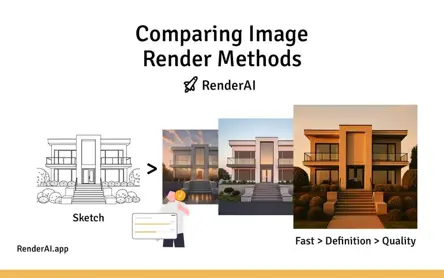
The methods differ in speed, cost and output size:
| Method | Typical time | Tokens per image | Output |
|---|---|---|---|
| Instant-Edit | 1 to 5 s | 1 | Quick edits on an existing image |
| Fast-Definition | 5 to 20 s | 2 | Detailed image, multi-image reference |
| Creative-Editor | 10 to 90 s | 3 | 2K |
| Creative-Quality | 10 to 60 s | 4 | 2K |
| Ultra-Quality 4K (Pro plans) | 10 to 60 s | 10 | 4K |
You can try it with your sketch using the free trial tokens. On Pro plans, the upscalers also take a render up to 6K.
Midjourney vs RenderAI: comparison table
| Midjourney (V8.2) | RenderAI | |
|---|---|---|
| How the sketch is used | Reference for a text prompt (Image Prompt, Remix or Edit Model) | Input image the render is built on |
| Geometry fidelity | Not documented as a constraint. Expect several iterations | Composition follows the sketch. Results vary by method and drawing quality |
| Control | Prompt, --iw, style references, moodboards, Editor | Method, style, prompt, Instant-Edit for small changes |
| Speed | Billed in GPU time: 0.8 min for SD, 1.3 min for HD | 1 to 90 s per image, depending on method |
| Price model | Subscription from $10 to $120 per month, based on GPU hours | Token plans, 1 to 10 tokens per image, 10 free trial tokens (pricing) |
| Output resolution | 2048 px in HD mode | 2K by default. 4K and upscaling up to 6K on Pro plans |
| Best for | Mood images and style exploration | Renders of a specific sketch or 3D view for clients |
Midjourney plan prices and GPU times are from Midjourney’s documentation in October 2026. Check the official pages before you subscribe, since they change often.
When to use each one
Use Midjourney when the sketch is a starting idea and you want the AI to propose atmosphere, materials or a visual style. It works well for mood boards and competition imagery, where the exact proportions of the drawing are less important than the feeling of the image.
Use RenderAI when the drawing already defines the project and the render has to show that design. That covers client presentations and real-estate marketing from early sketches or 3D screenshots. For the concepts behind both approaches, see the AI rendering concepts guide.
Some teams use both. Midjourney for early mood images, then RenderAI once the design is drawn.
—
References:
- Based on the video Sketch-to-Photo with Midjourney “Remix Mode” by Tokenized AI by Christian Heidorn. Sketch and Midjourney images by Christian Heidorn.
- Midjourney documentation: Version, Image Prompts, Remix, Upscalers and Comparing Midjourney Plans.
- Midjourney update: Edit Model for V8 (August 27, 2026).
- This content uses AI research assistance with RenderAI expert analysis and human editing.
Tags:
About the Author:
This article was written by Francisco. Architect, Visual Designer & Founder of RenderAI.